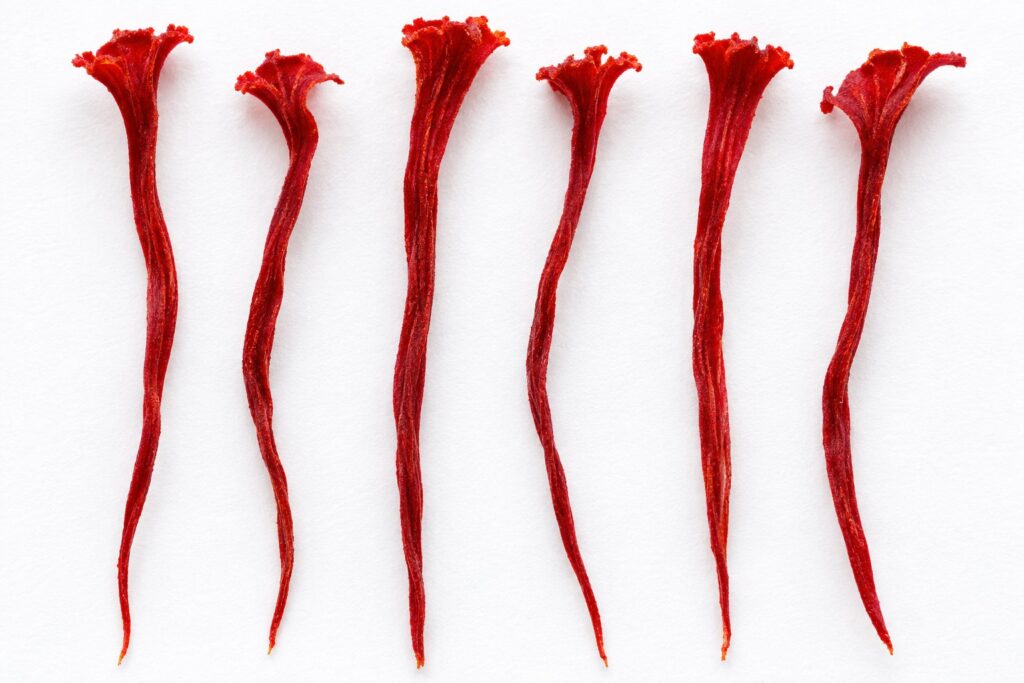
Super Negin is the name Iranian saffron traders give to their best-looking threads: only the red stigma, cut long, separated and strikingly even. This page explains what the name does and does not tell you, how it compares with Negin, Sargol and Pushal, what it costs per gram, how much you need, and how to check what you have bought.
What “Super Negin” means
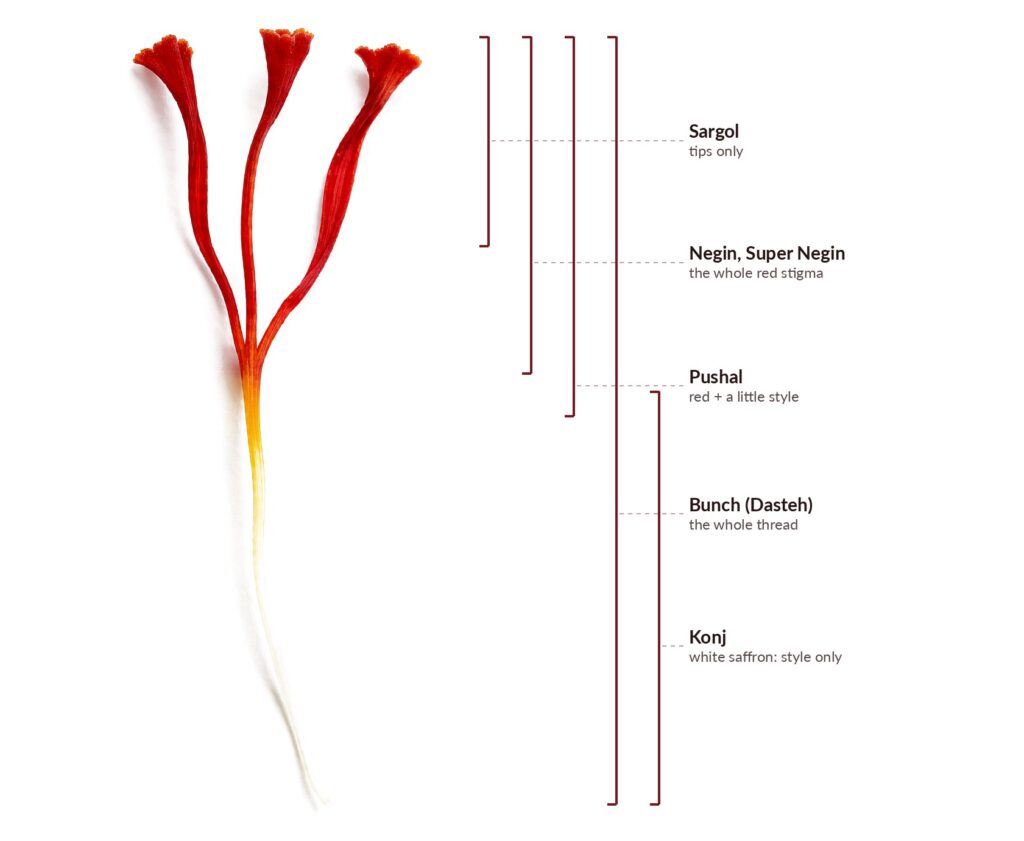
Every saffron flower (Crocus sativus) gives three threads. Each thread is a deep red stigma on top of a pale yellow-white style. The red part carries the colour, the taste and the aroma. The pale part carries very little of any of them, but it weighs the same on the scale.
Iranian grade names describe how much of the pale part was left on and how good the red part looks. Super Negin is the top of that scale:
- only red stigma, no pale style;
- long, thick threads, cut and separated rather than left in bundles;
- very uniform in length and colour, with few broken pieces.
It is a trade name, not a laboratory result. It tells you how the threads were sorted and cut. It does not by itself tell you how strong the colour, bitterness and aroma are. That is what the ISO 3632 test measures (see below).
Super Negin, Negin, Sargol, Pushal: the difference
| Grade | What is in the tin | What you notice |
|---|---|---|
| Super Negin | All red, long, thick, unbroken, very uniform threads | The most colour per gram and the best-looking saffron. Highest price. |
| Negin | All red, long, slightly less uniform | Very close in the pan. The difference is mostly in appearance. |
| Sargol | All red, shorter and more broken: the tips of the stigma | Strong, less impressive to look at. Often good value. |
| Pushal | Red stigma with a short piece of pale style attached | Cheaper per gram, but part of what you pay for adds nothing to the dish. |
| Dasteh (bunch) | Whole threads, style and all, tied in bundles | Traditional format, least colour per gram. |
Super Negin vs Negin is the question we hear most. Both are all-red. Super Negin is sorted harder: longer, thicker, more even threads. In a risotto you will struggle to tell them apart; in the tin, side by side, you will not. The full comparison is in Super Negin, Sargol, Pushal: what saffron grades actually mean.
Compared with pictures: Super Negin vs Negin vs Sargol: the difference, side by side.
Super Negin and ISO 3632
ISO 3632 is the international standard for saffron. A laboratory measures three things in the threads: colouring strength (crocin), bitterness (picrocrocin) and aroma (safranal), plus moisture and the absence of synthetic dyes. The result is a category, the highest being Special Grade in the 2025 edition of the standard.
The two systems answer different questions. Super Negin says how the threads look. ISO 3632 says what they measure. A trustworthy seller can show you both.
Our current lot was tested by Eurofins in Hamburg and measured ISO 3632 Special Grade. Every figure, with its measurement uncertainty, is on our lab results page, and the full report is available on request. How to read such a report: What ISO 3632 means, and how to read a saffron grade.
Super Negin saffron price
Saffron is sold by the gram, and smaller tins cost more per gram. Compare on the price per gram, and remember that a cheaper grade carrying pale style is not always cheaper per dish: you use more of it for the same colour.
Our prices, Super Negin from Iran, sealed aluminium tin, delivery included in Switzerland and Liechtenstein:
| Tin | Price | Per gram |
|---|---|---|
| 1 g | CHF 14.90 | CHF 14.90 |
| 2 g | CHF 24.90 | CHF 12.45 |
| 5 g | CHF 49.90 | CHF 9.98 |
| 10 g | CHF 76.00 | CHF 7.60 |
How much Super Negin do you need?
Less than people expect. A generous pinch is about 0.1 g, enough to colour and flavour a risotto or a pot of rice for four. So a 2 g tin is roughly twenty dishes, and a 1 g tin is a fair first try.
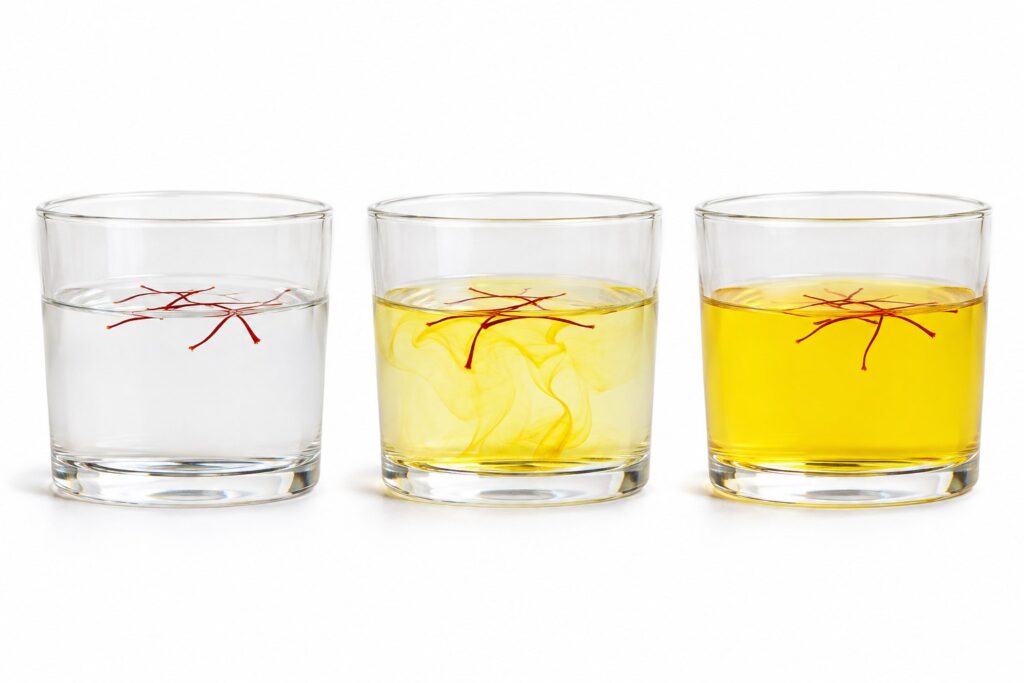
Steep the threads in a few spoonfuls of warm water or stock for at least 20 minutes before they go into the pan; the colour and aroma need time to leave the thread. A thread weighs 2 to 3 milligrams, so 0.1 g is 30 to 40 threads. Details, dish by dish, in How much saffron do I actually use?, and a worked example in Risotto alla Milanese: how much saffron, and why you steep first.
How to tell real Super Negin
- Threads, not powder. Powder cannot be inspected, and it is where adulteration happens.
- All red, with trumpet-shaped tips. A real stigma flares slightly at the top. Dyed safflower and corn silk do not.
- Colour that arrives slowly. In warm water, real saffron releases gold over several minutes and the threads stay red. Instant orange, and threads turning pale, mean dye.
- A smell you notice as soon as the tin opens: hay, honey, a faint metallic edge.
- Dry, loose threads. Oily or clumped threads were often weighted with moisture.
Six checks you can do at home: Real or fake? Six ways to check your saffron.
Storing it
Keep the tin closed, dark, cool and dry, away from the stove. Saffron does not spoil quickly, but its aroma fades with light, heat and air. The lot number and best-before date are printed on every tin.
Buying Super Negin saffron in Switzerland
Swiss Saffron Asadi sells Royal Saffron: Super Negin saffron, origin Iran, in whole threads, weighed and sealed in aluminium tins in Lausanne, with the lot number on every tin.
Only the top grade, and nothing else. We work exclusively with Super Negin, the highest Iranian grade. We do not sell Negin, Sargol, Pushal, blends or powder, and we will not add a cheaper grade to reach a lower price. We would rather sell less saffron than lower the standard: our name is on every tin.
- Tins of 1, 2, 5 and 10 g.
- Free delivery anywhere in Switzerland and Liechtenstein, dispatched within two working days.
- Free pickup in Lausanne by appointment.
- Pay by card, TWINT or QR-bill.
Questions
Is Super Negin the best saffron grade?
It is the highest of the Iranian trade grades, which sort by appearance and cut. Strength is a separate question, answered by an ISO 3632 laboratory test. The best saffron is one that has both.
Why is Super Negin more expensive than Sargol or Pushal?
Because it takes more sorting: only the longest, most even all-red threads qualify, and nothing pale is left on. You pay for the selection and for weight that is all stigma.
Is Super Negin the same as Persian saffron?
Super Negin is a grade of Persian (Iranian) saffron. “Persian saffron” says where it comes from; “Super Negin” says how it was sorted.
Do you ship outside Switzerland?
No. We deliver to Switzerland and Liechtenstein only. A gift ordered from abroad to a Swiss address is fine.