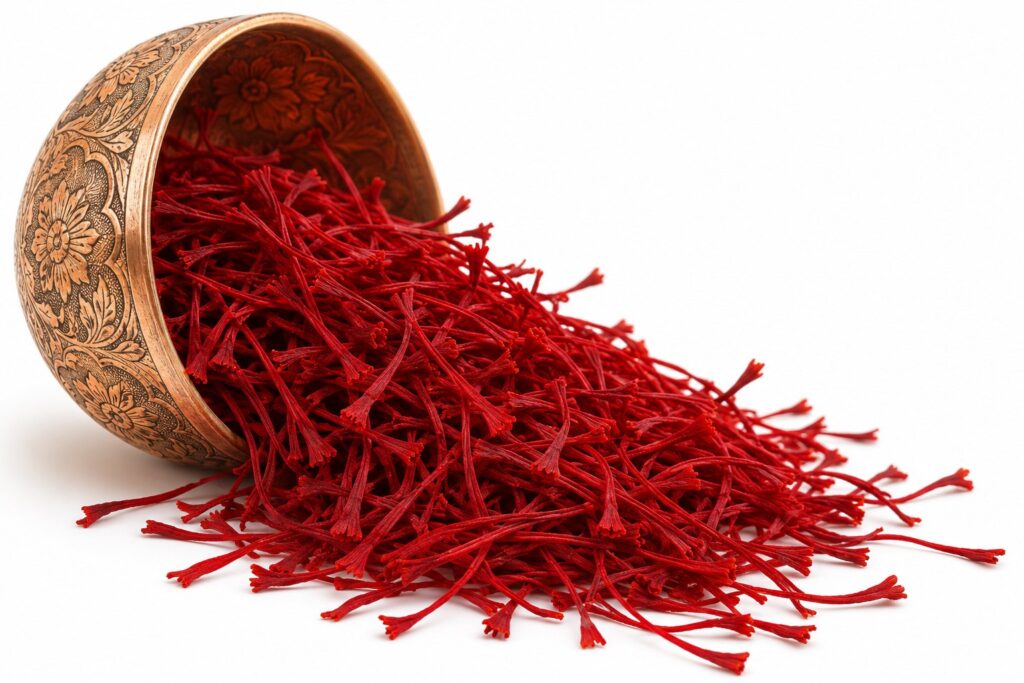
Super Negin, Negin and Sargol are all all-red saffron: no pale style left on the thread. So what are you paying for when one costs more than the other? Mostly length, thickness and how hard the threads were sorted. This page puts the three side by side, with pictures, and tells you when the difference matters in the kitchen and when it does not. We sell only one of them, Super Negin, and the end of this page explains why.
The short answer
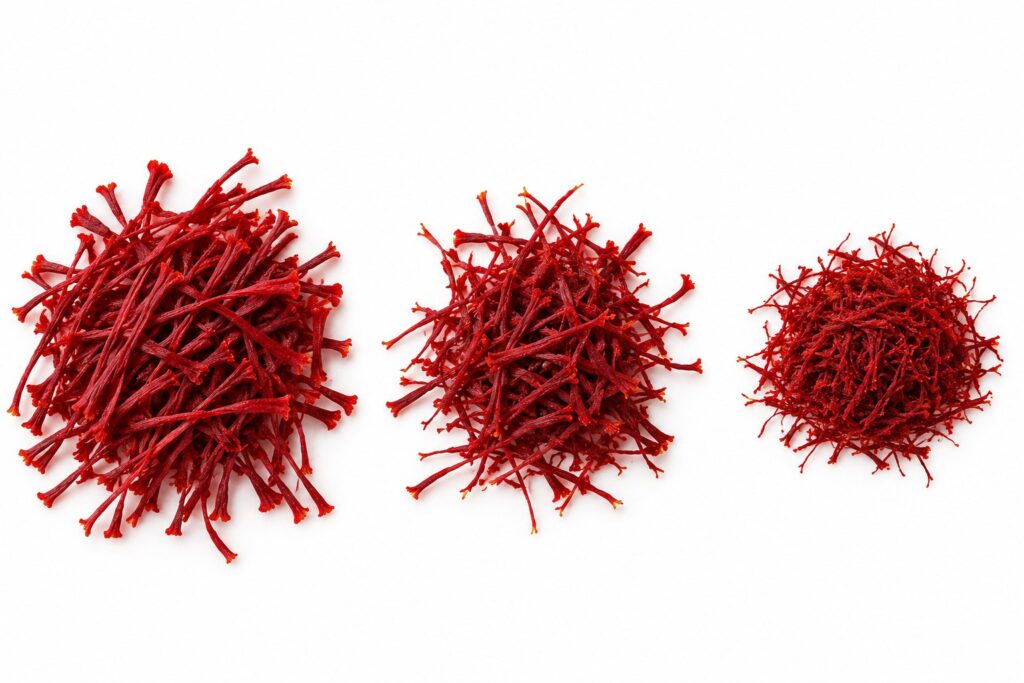
- Super Negin vs Negin: same part of the flower, both all red. Super Negin is sorted harder: longer, thicker, more even threads, almost no broken pieces. In a risotto you will struggle to tell them apart; in the tin, side by side, you see it at once.
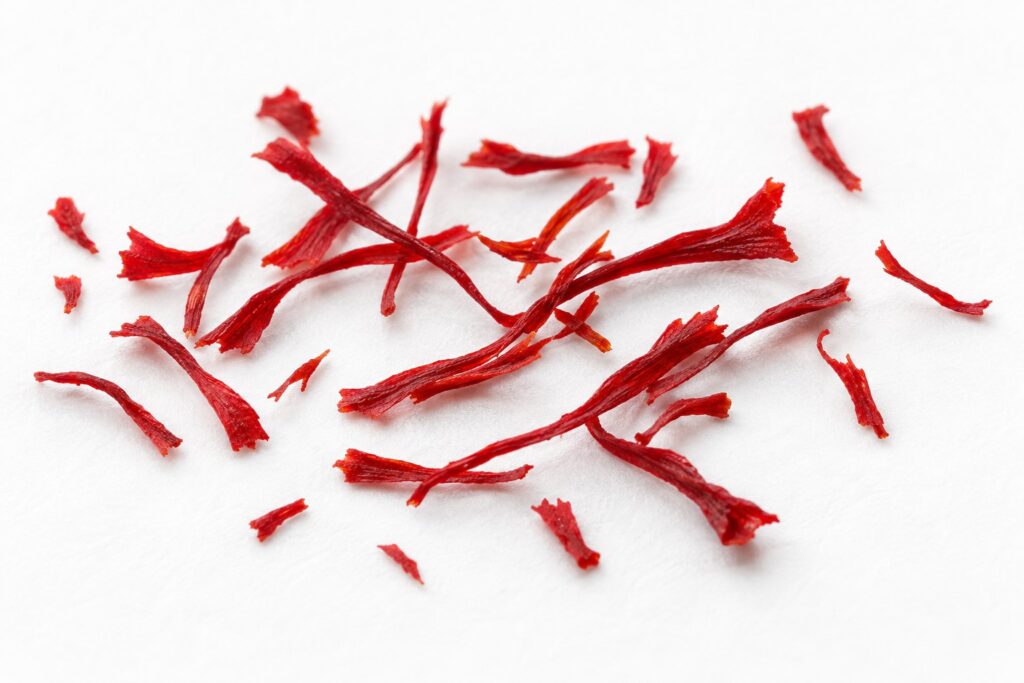
- Negin vs Sargol: Sargol is also all red, but it is the tip of the stigma, cut shorter, with more broken pieces. Strong in the pan, less impressive in the tin, often cheaper.
- None of the three names is a lab result. They describe how the threads were cut and sorted. How strong a saffron is (colour, bitterness, aroma) is measured separately, under ISO 3632.
Where the names come from
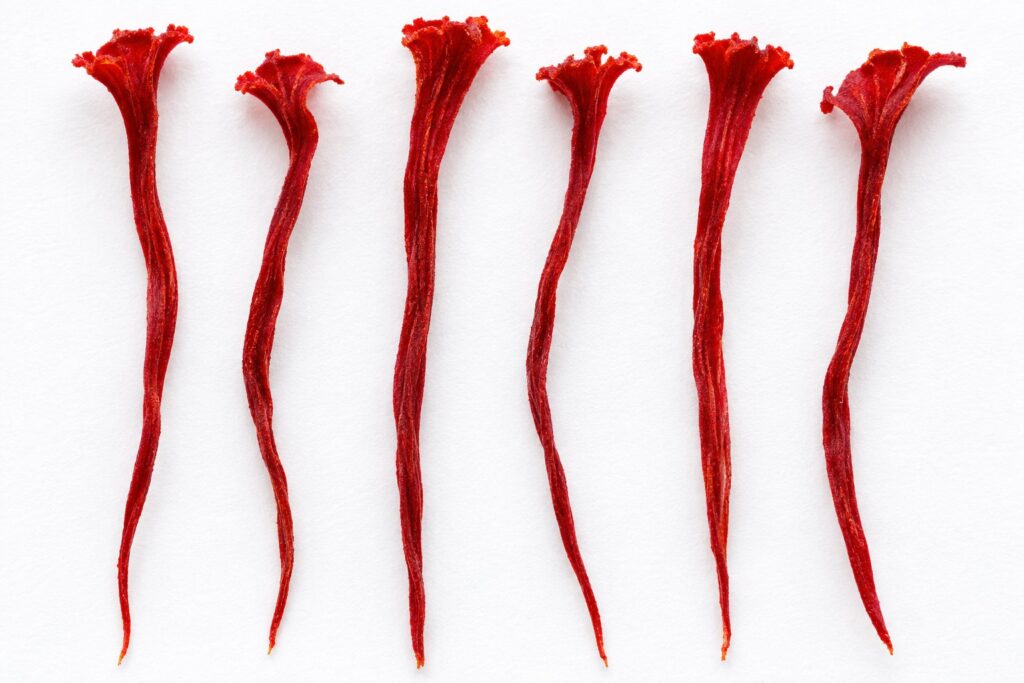
Every Crocus sativus flower gives three threads. Each thread is a deep red stigma on top of a pale yellow-white style. The red part carries the colour, the taste and the aroma; the pale part carries very little of any of them, but it weighs the same.
Iranian traders sort the dried threads into grades by two questions: how much of the pale style was cut off, and how long, thick and even are the red threads that remain. Super Negin, Negin and Sargol all answer the first question the same way, with none. They differ on the second. (Negin is sometimes spelled Nagin on Western labels; it is the same grade.)
Side by side
| Super Negin | Negin | Sargol | |
|---|---|---|---|
| Part of the thread | Red stigma only | Red stigma only | Red stigma only, mostly the tips |
| Length | Long | Long | Short |
| Thickness | Thick, flat, trumpet-shaped tips | Thick, a little less even | Thinner, more variable |
| Broken pieces | Very few | Some | Many |
| Look in the tin | Strikingly uniform, deep red | Red, slightly mixed lengths | Red, short and fluffy |
| Price | Highest | A little lower | Lower |
Super Negin vs Negin: is the difference worth it?
Both are cut above the pale style, so every milligram you pay for is red stigma. The extra sorting that turns Negin into Super Negin buys you longer, more even threads and fewer broken bits. That matters most when the threads are seen: scattered over a finished dish, in a gift tin, or when you want to check what you bought, because long whole threads are hard to fake and easy to inspect.
In the pan, after twenty minutes of steeping, the gap narrows. If you only ever grind your saffron into a sauce, a good Negin will serve you well. If you want to see, smell and judge the threads, Super Negin is the grade made for that.
Negin vs Sargol
Sargol is the top part of the stigma, cut shorter. Because it is still all red, its strength can be close to the longer grades: one Tehran wholesaler that publishes a lab figure next to every price lists a colouring strength (crocin) of about 250–260 for its Super Negin and about 235 for its Sargol. What you lose with Sargol is mainly the look: short, broken threads that are harder to inspect and easier to mix with other material.
What the name does not tell you
A grade name says how the threads were cut and sorted. It does not say how fresh they are, how they were dried or stored, or how strong they are. Two tins both labelled Super Negin can be very different in the pan. That is why the international standard, ISO 3632, measures colouring strength, bitterness and aroma in a laboratory.
So the useful question is not only “which grade?” but “which grade, and what did the lab measure?” A seller who can show you both is a seller you can check.
The water test: the same for every grade
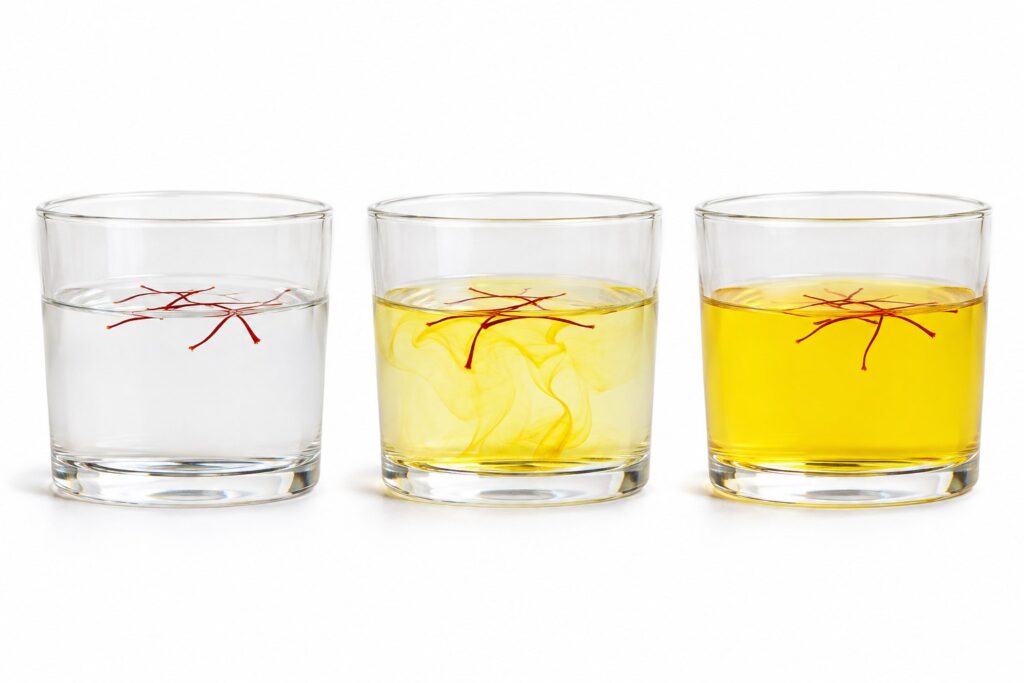
Put three or four threads in a small glass of warm water. Real saffron releases a golden-yellow colour slowly, over several minutes, and the threads stay red. Instant orange, or threads that turn pale, point to dye. This works for Super Negin, Negin and Sargol alike, and it is one of six checks you can do at home.
How much you need, whatever the grade
Less than most people expect. A generous pinch, about 0.1 g or 30 to 40 threads, colours and flavours a risotto or a pot of rice for four. Steep it first, in a few spoonfuls of warm water or stock, for at least 20 minutes. More in how much saffron do I actually use?
Questions
Is Super Negin better than Negin?
It is sorted harder: longer, thicker, more even threads with fewer broken pieces. Both are all red. For flavour the difference is small; for looks and for checking what you bought, Super Negin wins.
Is Sargol real saffron?
Yes. Sargol is all-red saffron cut from the top of the stigma. It is shorter and more broken, which is why it costs less.
Which grade is the strongest?
The grade name cannot tell you. Strength is measured under ISO 3632. All-red grades tend to measure higher than grades that keep pale style, such as Pushal, but within the all-red grades the lot matters more than the name.
What is the difference between Negin and Nagin?
None. It is the same Persian word written two ways.
What we sell
We sell only Super Negin, and that is a choice. We do not sell Negin, Sargol or Pushal, and we will not add a cheaper grade to reach a lower price. Super Negin is the grade you can judge with your own eyes: long, whole, all-red threads, nothing hidden in broken pieces. Our name is on every tin, so the quality does not go down.
What is in the tin: Super Negin from Iran, in whole threads, weighed and sealed in aluminium tins of 1, 2, 5, 10 and 20 g in Lausanne, with the lot number on every tin. The current lot was tested by an independent laboratory to ISO 3632; every figure is on our lab results page. Delivery is free in Switzerland and Liechtenstein.
Read next
- Super Negin saffron: what it is, what it costs, how to tell it
- Super Negin, Sargol, Pushal: what saffron grades actually mean
- Real or fake? Six ways to check your saffron
Our saffron: Super Negin from Iran, whole threads in sealed tins of 1 to 20 g, lab-tested to ISO 3632. See the tins →